The Silent Revolution
Month : 2026-07
Twenty years of transformation in anti-cancer therapies — and why nuclear medicine is at the heart of the convergence
Estimated reading time: ~18 minutes · Audience: physicians, medical physicists, radiopharmacists, nuclear medicine technologists and nurses.
A Paradigm Shift
For most of the 20th century, treating cancer meant poisoning a fast-dividing cell while hoping to spare the others. Cytotoxic chemotherapy, born in the 1940s, did not "see" its target: it struck all dividing cells, both tumor and healthy, and the clinician's art consisted of dosing the poison as close as possible to the threshold of tolerance.
In about twenty years, the foundation has changed. In the United States, the cancer mortality rate fell by 34% between 1991 and 2022, representing approximately 4.5 million avoided deaths — progress attributed to the decline in smoking, screening, but also, increasingly, to targeted therapies and immunotherapy1. Behind this figure lies a deeper transformation: the transition from a logic of non-specific destruction to a logic of molecular precision, where a characteristic specific to the tumor is identified to target it, treat it — and, increasingly, to see it.
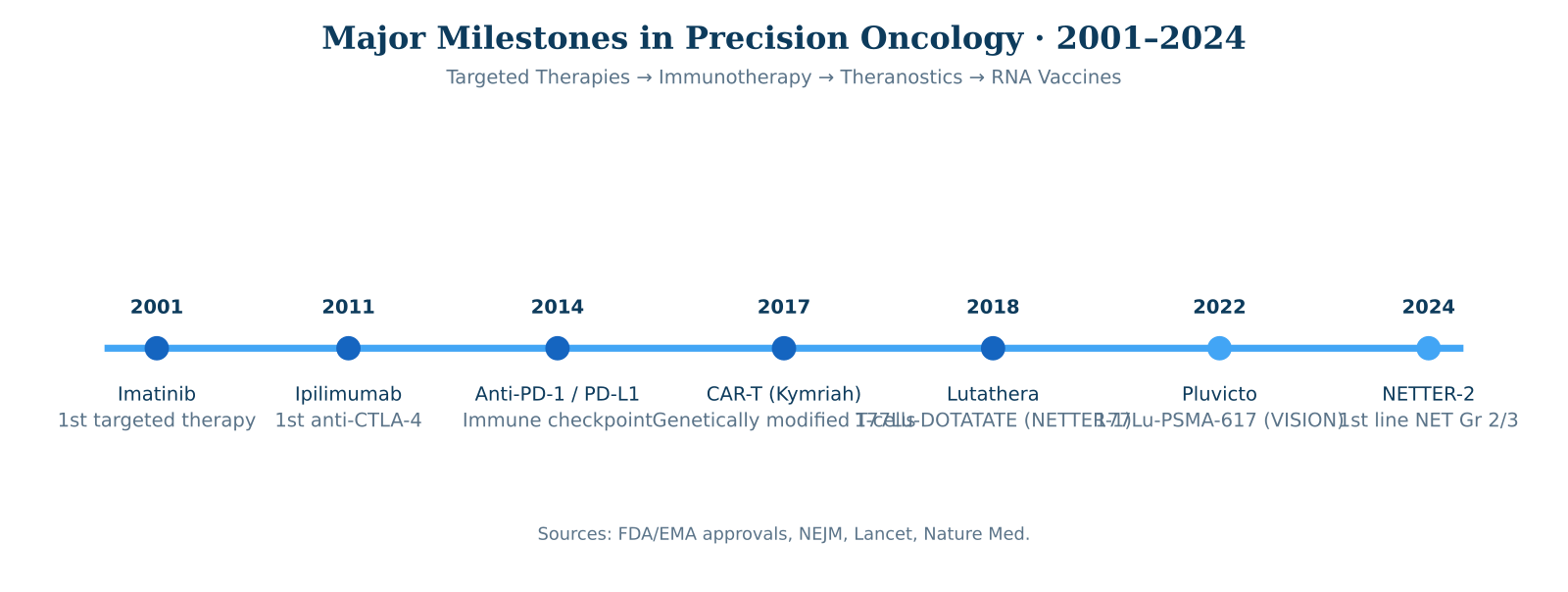
This report traces this shift through four of its most active fronts: targeted therapies, cellular immunotherapy (CAR-T) now at the doorstep of solid tumors, RNA cancer vaccines, and — at greater length, as this is where our discipline sits at the forefront — theranostics, the approach where the same molecular target serves both to image and to treat.
From Chemotherapy to the Molecular Target
The first major turning point was that of targeted therapies. The founding example remains imatinib in chronic myeloid leukemia (CML), driven by a single molecular abnormality — the BCR-ABL fusion protein. In 2001, an inhibitor designed to specifically block this kinase transformed the prognosis of a disease that was previously often fatal2. Long-term follow-up of the IRIS trial confirmed a ten-year overall survival of 83%, whereas CML was previously a medium-term death sentence3.
The lesson went beyond CML: if the molecular driver of a cancer is known, a molecule can be designed to shut it down. From this principle, dozens of targeted therapies were born, each backed by a biomarker that identifies patients likely to benefit.
Targeted therapy introduced an idea that structures all modern oncology: every treatment must correspond to a means of verifying that its target is present. This companion test is sometimes molecular — and, in nuclear medicine, it becomes an image.
Immunotherapy: Rearming the Immune System
The second turning point moved the target: rather than attacking the tumor directly, we learned to release the brakes on the immune system. Checkpoint inhibitors block the signals by which the tumor puts T lymphocytes to sleep. In metastatic melanoma, the combination of nivolumab + ipilimumab brought five-year survival to 52%, a result unthinkable in the era of chemotherapy alone4.
CAR-T: From Hematology to the Wall of Solid Tumors
CAR-T cells are T cells collected from the patient, genetically modified to express an artificial receptor directed against a tumor antigen, and then reinjected. In hematological malignancies, they have produced spectacular remissions since 2017. The transition to solid tumors, which represent nearly 90% of cancers, hit a wall: absence of ideal antigens, difficulty of infiltration, and an immunosuppressive microenvironment.
The recent period marks a shift. Anti-claudin 18.2 CAR-Ts have shown tangible activity in advanced gastrointestinal cancers6. In high-risk pediatric neuroblastoma, 3rd generation anti-GD2 CAR-Ts achieved durable responses5. Anti-B7-H3 CAR-Ts injected directly into the cerebral ventricular system produced unprecedented responses in diffuse intrinsic pontine glioma7, and anti-HER2 CAR-Ts showed encouraging activity in advanced sarcomas8.
The wall of solid tumors has not fallen — but for the first time, reproducible breaches are visible.
We must remain clear-eyed: to date, no conventional CAR-T is approved for a solid tumor. The regulatory milestones of 2024 concerned related but distinct cell therapies — a transgenic T-cell receptor in synovial sarcoma, and tumor-infiltrating lymphocytes in melanoma.
CAR-Ts expose patients to two specific toxicities — cytokine release syndrome (CRS) and neurotoxicity (ICANS) — which require expert management.
Cancer Vaccines: The Era of Personalized RNA
A therapeutic cancer vaccine teaches the immune system to recognize tumor cells already present. The recent breakthrough comes from neoantigens — mutated proteins specific to a patient's tumor — and messenger RNA, which allows for the manufacture of a bespoke vaccine in a few weeks.
In melanoma, the KEYNOTE-942 trial tested a personalized RNA vaccine (mRNA-4157/V940) combined with pembrolizumab after surgery: recurrence-free survival benefit maintained at three years9. Even more striking, in pancreatic cancer — a tumor notoriously considered "cold" — a personalized RNA vaccine (autogene cevumeran) induced specific T cells in half of the patients; these responders had a significantly prolonged recurrence-free survival10, and follow-up at more than three years showed that these T cells persisted, with some clones having an estimated lifespan in years11.
Bespoke CAR-Ts and personalized RNA vaccines share the same logic: exploiting the unique molecular signature of a patient's tumor.
Theranostics: Seeing the Target Before Treating It
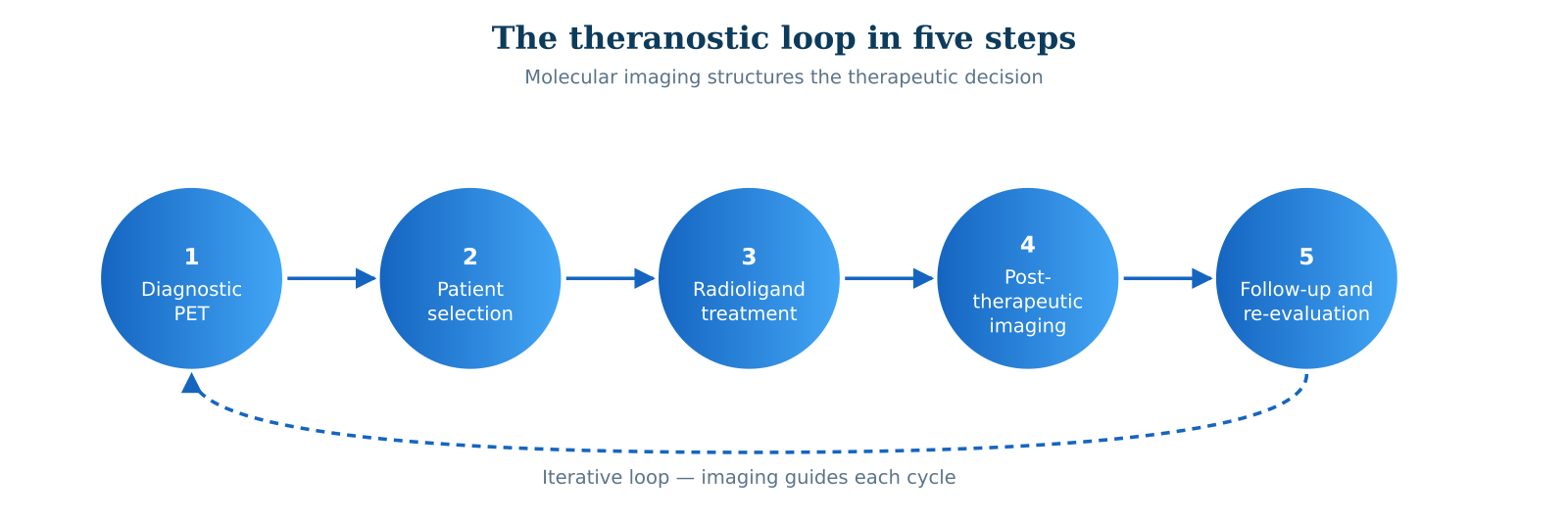
We come to the heart of our discipline. Theranostics is based on a principle of rare elegance: using the same molecular target to image the disease and to treat it. A vector is coupled to a radioactive isotope; depending on the isotope chosen, the same vector becomes an imaging tracer or a therapeutic agent.
Concretely, the vector is labeled with a positron emitter (gallium-68, fluorine-18) to perform a PET scan: the image shows where the target is expressed. If uptake is clear, the same vector labeled this time with a particle emitter — most often lutetium-177 — is administered, which delivers its dose in direct contact with the target cells. This is the meaning of the principle "see what you treat, treat what you see."
Prostate Cancer: The PSMA Paradigm
The PSMA antigen is overexpressed by the vast majority of prostate cancers. PSMA PET identifies patients whose lesions actually express the target, who can then receive lutetium-177-PSMA-617. The VISION trial showed, in heavily pretreated patients, an overall survival increased from 11.3 to 15.3 months (a 38% reduction in the risk of death)12. The TheraP trial compared the radioligand to cabazitaxel with selection by dual PET imaging13. PSMAfore confirmed the benefit from an earlier line of treatment14.
Neuroendocrine Tumors: The SSTR2 Model
The same logic applies to gastroenteropancreatic neuroendocrine tumors, which overexpress the somatostatin receptor SSTR2. The NETTER-1 trial showed a progression-free survival increased to 28.4 months compared to 8.5 months under high-dose octreotide15. The more recent NETTER-2 trial took a further step: in first-line therapy, Lu-177-DOTATATE almost tripled progression-free survival (22.8 vs 8.5 months)17 — the first randomized trial demonstrating the value of a radioligand in the first-line setting for a metastatic solid tumor.
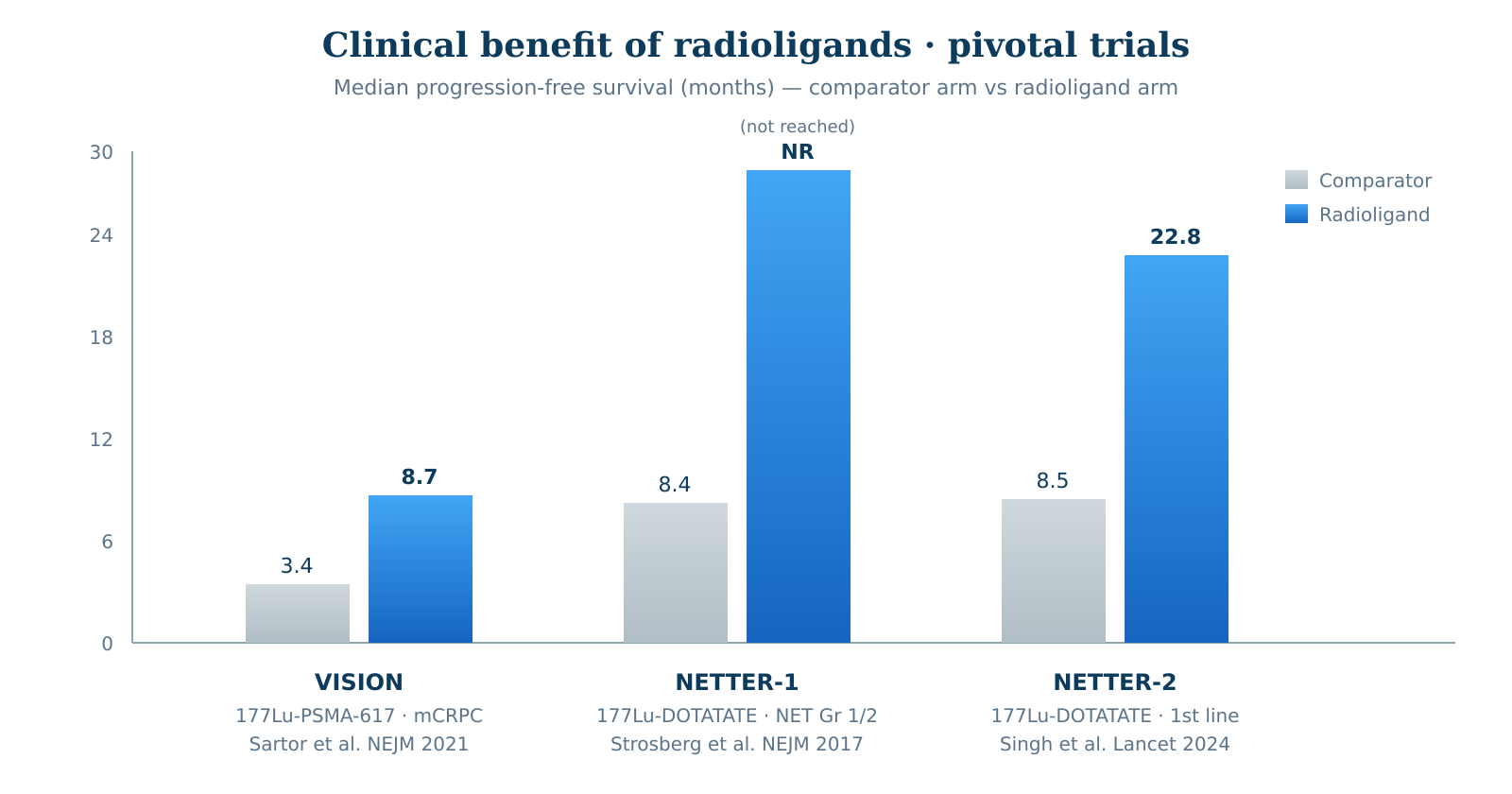
In prostate cancer as in neuroendocrine tumors, a PET image qualifies the patient, then the same vector, marked by a therapeutic isotope, delivers the dose. Imaging is not a subsidiary exam — it is the companion test that conditions and validates the treatment.
Beyond Lutetium: Alpha Particles and New Targets
Theranostics is in full expansion. Alpha particle emitters, such as actinium-225, deliver more concentrated energy over a very short distance: Ac-225-PSMA-617 has shown responses in patients refractory to lutetium19. FAPI inhibitors, which bind to the tumor stroma, show avid uptake in dozens of types of cancers and open a potentially pan-tumor path18 — a dynamic outlined in a now well-defined roadmap for the development of radiotheranostics20.
The growth of theranostics imposes concrete constraints: isotope supply, radioprotection, personalized dosimetry, radiopharmacy workflows, and team training.
A Medicine of Convergence
From a distance, these four fronts seem to belong to separate worlds. In reality, they all obey the same logic: identifying a molecular characteristic of the tumor and exploiting it. This convergence has a direct consequence for nuclear medicine: the decisive question is always is the target actually present, and where? — which is exactly what a molecular image can answer.
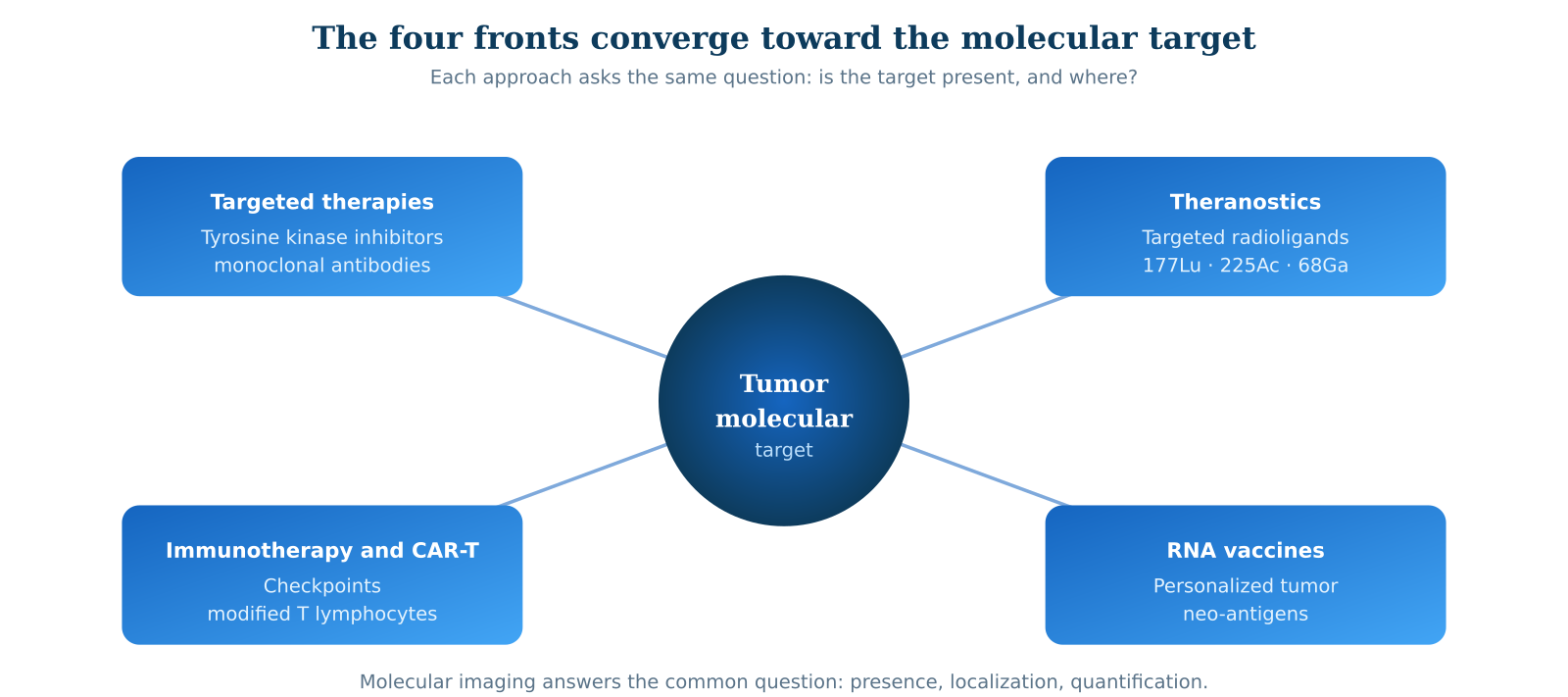
Combinations are beginning to emerge: associating a radioligand with an immunotherapy, or using molecular imaging to monitor the response to a vaccine or to CAR-Ts. The border between diagnosis and therapy is blurring, and nuclear medicine finds itself, almost naturally, at the meeting point.
Conclusion
In twenty years, oncology has moved from a medicine of destruction to a medicine of precision. Targeted therapies established the principle of the companion biomarker. Immunotherapy showed that a rearmed immune system could provide long-term control of the disease. CAR-Ts are cautiously beginning the conquest of solid tumors. Personalized RNA vaccines provide clinical proof that immunity can be taught to recognize a tumor, even in the pancreas.
And theranostics, by coupling the same target to imaging and treatment, embodies perhaps the most advanced form of this precision: it does not just treat, it shows what it treats. It places nuclear medicine no longer at the periphery of the oncological pathway, but at its center. Considerable challenges remain — equitable access, isotope supply, training, robustness of long-term evidence. The revolution is real but incomplete. Its next stage will take place, in large part, in our departments.
Key points to remember • Decreasing mortality — −34% cancer mortality in the USA between 1991 and 2022 (~4.5 million avoided deaths), partially driven by targeted therapies and immunotherapy. • Targeted therapy — the imatinib/CML model established the "one molecular target, one treatment, one companion test" principle. • Immunotherapy — checkpoint inhibitors have permanently transformed the prognosis of cancers such as melanoma. • CAR-T & solid tumors — promising phase 1 signals (claudine 18.2, GD2, B7-H3, HER2), but no conventional CAR-T yet approved outside hematology. • RNA vaccines — clinical proof in melanoma (KEYNOTE-942) and strong signal in the pancreas (autogene cevumeran). • Theranostics — principle — the same target serves to image (PET) and to treat (radioligand); the image validates and verifies the treatment. • PSMA / prostate — Lu-177-PSMA-617 prolongs survival (VISION); PET imaging as a selection test (TheraP, PSMAfore). • SSTR2 / neuroendocrine tumors — Lu-177-DOTATATE effective in late-line (NETTER-1) and now in first-line (NETTER-2) settings. • Horizons — alpha emitters (Ac-225), pan-tumor targets (FAPI), combinations with immunotherapy. • Disciplinary stakes — nuclear medicine is moving from the role of imager to that of a central therapeutic actor in precision oncology.
• Siegel RL, Kratzer TB, Giaquinto AN, Sung H, Jemal A. Cancer statistics, 2025. CA Cancer J Clin. 2025;75(1):10-45. https://doi.org/10.3322/caac.21871 • Druker BJ, Talpaz M, Resta DJ, et al. Efficacy and safety of a specific inhibitor of the BCR-ABL tyrosine kinase in chronic myeloid leukemia. N Engl J Med. 2001;344(14):1031-1037. https://doi.org/10.1056/NEJM200104053441401 • Hochhaus A, Larson RA, Guilhot F, et al. Long-term outcomes of imatinib treatment for chronic myeloid leukemia. N Engl J Med. 2017;376(10):917-927. https://doi.org/10.1056/NEJMoa1609324 • Larkin J, Chiarion-Sileni V, Gonzalez R, et al. Five-year survival with combined nivolumab and ipilimumab in advanced melanoma. N Engl J Med. 2019;381(16):1535-1546. https://doi.org/10.1056/NEJMoa1910836 • Del Bufalo F, De Angelis B, Caruana I, et al. GD2-CART01 for relapsed or refractory high-risk neuroblastoma. N Engl J Med. 2023;388(14):1284-1295. https://doi.org/10.1056/NEJMoa2210859 • Qi C, Liu C, Gong J, et al. Claudin18.2-specific CAR T cells in gastrointestinal cancers: phase 1 trial final results. Nat Med. 2024;30(8):2224-2234. https://doi.org/10.1038/s41591-024-03037-z • Vitanza NA, Ronsley R, Choe M, et al. Intracerebroventricular B7-H3-targeting CAR T cells for diffuse intrinsic pontine glioma: a phase 1 trial. Nat Med. 2025;31(3):861-868. https://doi.org/10.1038/s41591-024-03451-3 • Hegde M, Navai S, DeRenzo C, et al. Autologous HER2-specific CAR T cells after lymphodepletion for advanced sarcoma: a phase 1 trial. Nat Cancer. 2024;5(6):880-894. https://doi.org/10.1038/s43018-024-00749-6 • Weber JS, Carlino MS, Khattak A, et al. Individualised neoantigen therapy mRNA-4157 (V940) plus pembrolizumab versus pembrolizumab monotherapy in resected melanoma (KEYNOTE-942): a randomised, phase 2b study. Lancet. 2024;403(10427):632-644. https://doi.org/10.1016/S0140-6736(23)02268-7 • Rojas LA, Sethna Z, Soares KC, et al. Personalized RNA neoantigen vaccines stimulate T cells in pancreatic cancer. Nature. 2023;618(7963):144-150. https://doi.org/10.1038/s41586-023-06063-y • Sethna Z, Guasp P, Reiche C, et al. RNA neoantigen vaccines prime long-lived CD8+ T cells in pancreatic cancer. Nature. 2025;639(8056):1042-1051. https://doi.org/10.1038/s41586-024-08508-4 • Sartor O, de Bono J, Chi KN, et al. Lutetium-177-PSMA-617 for metastatic castration-resistant prostate cancer. N Engl J Med. 2021;385(12):1091-1103. https://doi.org/10.1056/NEJMoa2107322 • Hofman MS, Emmett L, Sandhu S, et al. [177Lu]Lu-PSMA-617 versus cabazitaxel in patients with metastatic castration-resistant prostate cancer (TheraP): a randomised, open-label, phase 2 trial. Lancet. 2021;397(10276):797-804. https://doi.org/10.1016/S0140-6736(21)00237-3 • Morris MJ, Castellano D, Herrmann K, et al. 177Lu-PSMA-617 versus a change of androgen receptor pathway inhibitor therapy for taxane-naive patients with progressive metastatic castration-resistant prostate cancer (PSMAfore): a phase 3, randomised, controlled trial. Lancet. 2024;404(10459):1227-1239. https://doi.org/10.1016/S0140-6736(24)01653-2 • Strosberg J, El-Haddad G, Wolin E, et al. Phase 3 trial of 177Lu-Dotatate for midgut neuroendocrine tumors. N Engl J Med. 2017;376(2):125-135. https://doi.org/10.1056/NEJMoa1607427 • Strosberg JR, Caplin ME, Kunz PL, et al. 177Lu-Dotatate plus long-acting octreotide versus high-dose long-acting octreotide in patients with midgut neuroendocrine tumours (NETTER-1): final overall survival and long-term safety results from an open-label, randomised, controlled, phase 3 trial. Lancet Oncol. 2021;22(12):1752-1763. https://doi.org/10.1016/S1470-2045(21)00572-6 • Singh S, Halperin D, Myrehaug S, et al. [177Lu]Lu-DOTA-TATE plus long-acting octreotide versus high-dose long-acting octreotide for the treatment of newly diagnosed, advanced grade 2-3, well-differentiated, gastroenteropancreatic neuroendocrine tumours (NETTER-2): an open-label, randomised, phase 3 study. Lancet. 2024;403(10446):2807-2817. https://doi.org/10.1016/S0140-6736(24)00701-3 • Kratochwil C, Flechsig P, Lindner T, et al. 68Ga-FAPI PET/CT: tracer uptake in 28 different kinds of cancer. J Nucl Med. 2019;60(6):801-805. https://doi.org/10.2967/jnumed.119.227967 • Kratochwil C, Bruchertseifer F, Giesel FL, et al. 225Ac-PSMA-617 for PSMA-targeted α-radiation therapy of metastatic castration-resistant prostate cancer. J Nucl Med. 2016;57(12):1941-1944. https://doi.org/10.2967/jnumed.116.178673 • Herrmann K, Schwaiger M, Lewis JS, et al. Radiotheranostics: a roadmap for future development. Lancet Oncol. 2020;21(3):e146-e156. https://doi.org/10.1016/S1470-2045(19)30821-6